Googlr What Types of Arts and Crafts Did They Make on in the Plains Tribe
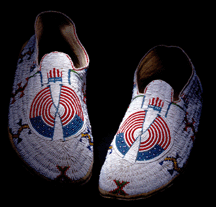
These moccasins were made around 1915 past Osage craftswoman Julia Pryor Mongrain Lookout and worn by her during special ceremonies honoring Osage participation in World War I. Private drove.
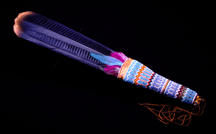
Waterbird fans, fabricated here from cormorant tail feathers with a beaded handle, are used past women in the Native American Church of the Osage.
"Art of the Osage," on view at the Saint Louis Fine art Museum through Baronial 8, gathers together more 100 objects fabricated betwixt 1750 and the nowadays twenty-four hour period by the American Indian people known as the Osage.
Although creative person George Catlin sketched the tribe's chief Clermont in 1834, the material civilization of the Osage remains footling known among art historians today. This Native American group never made art for art's sake; instead, they attempted to make all useful objects beautiful. The unfamiliarity of the outside earth with their creations results, in part, from the fact that – due to a series of fortunate economic circumstances – the Osage were never constrained to make appurtenances for sale to settlers or tourists.
Dr John Nunley, the Morton D. May curator of the arts of Africa, Oceania, and the Americas at the Saint Louis Art Museum, spent six years organizing the exhibition with the help of Osage tribal authorities. "This is really the start major exhibition on Osage art," he explains. "It is true that you hear more about the Mandan or the Oglala or other Plains Indians. But, when the Osage were at the height of their commercialization of the fur merchandise, they occupied an area that included Kansas, Missouri, Arkansas and Oklahoma. They processed bison in the plains but also lived in the eastern woodlands and on the prairie; they were involved in three unlike environments. This is another reason why people interested couldn't quite peg the Osage in whatsoever one identify."
The exhibit features a drove of objects with a "purposeful beauty characteristic" that spans a history of more than 250 years. Borrowed from a variety of prestigious sources, including the Osage Tribal Museum, the "Art of the Osage" projection chronicles the history, religion and guild of the tribe.
This does not mean that contact with Europeans did not change Osage life and art. In commutation for the furs traded to the French, the tribe received wool broadcloth, which replaced leather for vesture, guns and metal weapons to assist in their hunting, and decorative drinking glass beads, which became an important element in the graphic designs ornamenting every sort of object. Fine beadwork was used for patterns on articles of wear, such as belts and garters, on cradleboards used to carry infants, on ceremonial headdresses and on ritual implements, such as peyote fans and rattles.
Nunley too draws attention to other subtle changes brought about past contact with outside influences. Ane of his favorite objects in the exhibition is a quirt, or riding whip, fabricated of engraved elk antler, circa 1850, lent by the Detroit Institute of Arts. The outlined horses resemble prototypes that become back to the Paleolithic period and the frontal warriors are geometric in construction. The curator compares this case to another quirt, collected by Karl Bodmer in 1833, that depicts a more realistic warrior in three-quarter perspective, whose engraver seems to be copying images by trained European artists.
The refined artistic tradition of the Osage reflects the sense of continuity and purpose that has long united the Osage people in the values of spirituality and customs. Rich in pregnant and complex in its delivery to tradition and utility, Osage art is infused with artful vigor bound to exquisite simplicity.
Since Osage art ever has a practical orientation, many objects displayed in the exhibition are peculiarly busy wear or accessories reserved for ceremonial occasions. The about important of these are the traditional male dances of the E-Lon-schka societies, which have been an important keystone of Osage community life for the concluding 100 years. These ceremonies are this tribe'south version of the Grass Trip the light fantastic toe, which was adopted past many prairie and plains peoples in the belatedly Nineteenth Century. A distinctive element of the Osage costume for this event is the characteristic roach headdress attached to the caput by a roach spreader or platform, which helps requite the crest its flaring shape.
One bone roach spreader, on loan from the Smithsonian's National Museum of the American Indian, is decorated with a series of 3 stacked hearts, a mutual motif in Osage art. A consummate headdress, likewise on view, shows how the crest was constructed from the beard of a wild turkey and scarlet-dyed deer tail hair, which symbolize the fire and ashes of a prairie burn. Brightly colored beadwork terminating in wild bird feathers completes the headdress. Other rdf_Descriptions on display that were used in the E-Lon-schka dances include a ceremonial tail dancer's stick with beading and a trailer and fringed leggings worn by a male dancer.
Patriotic decorations appear in another group of exhibits continued with the participation of Osage soldiers in Earth War I. A special certificate of appreciation was signed by President Calvin Coolidge and presented by his representatives to tribal members at Pawhuska in 1924. Julia Lookout, one of the tribe's near important artists of the Twentieth Century, wore a special pair of moccasins she had decorated with beading incorporating the American flag and lightning motifs from Osage cosmology. The War Mothers Social club, founded around this time, as well made special wool blankets commemorating their sons' contributions; all four in the exhibition are busy with multiple American flags.
An interesting group of exhibits involve paraphernalia of the Osage peyote religion, introduced into the tribe in the 1890s by John Wilson, a Caddo-Delaware Indian who taught and constructed altars in the community for many years, gaining many converts. His followers were encouraged to abandon before tribal religious practices, even the E-Lon-schka trip the light fantastic. A pair of moccasins on brandish has beaded medallions representing peyote buttons. A ritual Big Moon Staff, borrowed from the Gilcrease Museum in Tulsa, is decorated with feathers, bells, possum hair and an otter's hibernate, which represents purity. A box holds a consummate peyote kit of liturgical implements, which would exist owned past each male member of the church building. Particularly cute is a peyote fan of macaw and eagle feathers with beaded shafts, used to steady and focus participants during the long church ritual.
A scholarly catalog has been published by the museum in conjunction with the University of Washington Printing. Nunley and Sean Standing Bear contributed the final chapter on "Osage Aesthetics," but the majority of the essays on history and faith were written past Bailey. It also includes rare black and white historical photographs dating from the 1870s, as well as excerpts from recorded interviews with members of the Osage Nation.
The Saint Louis Art Museum, located on Fine Arts Bulldoze in Forest Park, is offering the "Art of the Osage" exhibition as part of the Three Flags Festival commemorating the 200th anniversary of the formal transfer of the Louisiana Territory in St Louis on March 9-10, 1804. For information, 314-721-0072 or www.slam.org.
Source: https://www.antiquesandthearts.com/the-art-of-the-osage/
0 Response to "Googlr What Types of Arts and Crafts Did They Make on in the Plains Tribe"
ارسال یک نظر